




In the art world, there is an old saying that “good artists copy, great artists steal”. A number of the greatest artists in history were not shy about this wisdom. Let’s be clear: “steal” is metaphorical and does not mean theft or plagiarism. It can mean “observe, absorb and recreate”. In the legal world, the use of AI is revolutionizing the industry. What are the major benefits and accompanying risks of using AI at this juncture without compromising professional duties, and what measures should be considered to avoid pitfalls such as AI hallucination and plagiarism?
The art of utilizing legal AI for legal professionals
Philip Ng • 23 October 2026
The art of utilizing legal AI for legal professionals

Pitfalls
Over-reliance without human verification.
AI output may be false, misleading or biased because of insufficient or inaccurate training data, and generative AI generally produces output by predicting patterns in text rather than applying human reasoning.
AI hallucination appears when generative AI produces output that appears logical and correct, but is fabricated or false. Possible causes include misleading prompts, inadequate training data and the machine’s lack of a true and complete understanding of the underlying legal issues, factual patterns or human factors. Typical examples include fabricated case citations and non-existent statutes being incorporated into legal work without subsequent human verification. Such incidents have been reported in numerous jurisdictions including the UK and the US. They may expose lawyers to professional negligence claims. For the judiciary, they may undermine public trust in the administration of justice. If false authorities go undetected, they may also contaminate future legal reasoning in a common law system that depends on the organic evolution of precedents.
Recently, a High Court judge in Hong Kong was reported for repeated cases of judicial plagiarism involving the copying of substantial parts of one party’s arguments/submissions. This was not an AI case, but the principle is directly relevant. Although AI makes copying and repackaging text easier, it does not dilute the professional obligation to think independently. An independent judiciary producing well-reasoned judgements is essential to maintaining public confidence. Legal plagiarism or reckless use of AI may lead to injustice, appeals and retrials, further depleting the limited judicial resources.
Confidentiality. Inadvertent and uncontrolled connection of an AI tool to traditional office software may result in losing client confidentiality and legal professional privilege. It follows that using one particular device exclusively for AI may be advisable. Legal professionals must also be alert to personal data privacy, cybersecurity and copyright issues when uploading information or documents. AI may also produce biased output because of the peculiarities of its training data and its limited ability to evaluate wholly qualitative considerations.
Risk mitigation
The Smart prompts. Legal professionals should understand the importance of smart prompts and know when to “zoom out” with general and open-ended questions, to allow different perspectives and “zoom in” with specific and closed end questions, to allow more definitive answers. Prompts should define the precise structure and parameters of the task, including the relevant jurisdiction and permitted sources, and legal jargons should not be avoided where they improve precision. Complex tasks should be broken down, and the desired end-product should be stated concisely and clearly.
For instance, we can start off with “Summarize the contract law (statue and case law) on penalty clauses in Hong Kong”, then follow with “Based on the legal principle of genuine pre-estimate of loss, analyze Client A’s legal position under the contract [providing pertinent factual information] in terms of strengths/weaknesses and plausible counter-arguments”, so on and so forth.
Users should always maintain a questioning mindset, challenge the output through an “elaborate” or “refine” process, and most importantly, conduct a final “validate” process by requiring citations for legal authorities and checking them independently against authoritative sources. However, telling a model not to invent authorities does not make human verification optional.
Pseudonyms. Consider using pseudonyms instead of real names when interacting with AI to reduce confidentiality and personal data privacy risks. In a courtroom context, a certificate or confirmation that AI-derived material has been independently verified against authoritative sources could also be considered.
Specialised tools. Specialised legal AI services trained on authoritative and jurisdiction-specific legal databases may offer advantages over free public chatbots. More sophisticated AI agents with built-in verification tools can also be tailored to particular tasks, workflows and organizations.
AI policies. Courts, law firms, in-house legal teams and academic institutions should adopt robust and practically workable AI policies, provide relevant training and ensure consistent organizational approach that complies with professional or regulatory requirements.
For instance, the Hong Kong Judiciary and the Office of the Privacy Commissioner for Personal Data have issued guidelines in recent years on the use of generative AI for judges and judicial officers and by employees, respectively. The Hong Kong Department of Justice and the Law Society of Hong Kong have issued position papers, surveys etc. Policy safeguards should address these and other applicable regulatory requirements and the risk factors already identified.
Areas such as access and senior supervision on the use and approval of AI tools (for instance, Level 1 for general research using public materials; Level 2 for drafting contracts and advice; and Level 3 for uploading confidential or privileged data), use of official devices on trusted networks, limitation of personal devices and web-based tools outside the office, incident reporting, escalation and whistle blowing procedures should be considered.
Technology may change rapidly, while professional standards remain essentially the same over time. The key question is how to use AI vigilantly and responsibly. The legal professional exercising professional judgement must remain the final gatekeeper. The consensus of legal industry stakeholders is that legal professionals should avoid over-dependency on AI or any abrogation of legal duties and responsibilities as ultimately, they remain accountable.
YYC Legal LLP is in Association with East & Concord Partners (Hong Kong) Law Firm.
First published in September 2026 YYC Legal - legal trends of China Business Law Journal.
This material has been prepared for general informational purposes only and is not intended to be relied upon as professional advice. Please contact us for specific advice.
Recent articles

Technology‑driven companies are no longer judged only on what their AI can do, but on whether they can prove that it is governable, auditable, and investable.

The Northern Metropolis has been incorporated into China's 15th Five-Year Plan, reinforcing Hong Kong’s integration into the nation’s overall development strategy.

HKEX consistently emphasises importance of listed issuers complying with its listing rules. This article discusses several enforcement cases published by HKEX.

This article provides commentary on the consultation launched by HKEX in March 2026 to solicit market feedback on its proposed reforms aimed at listing framework.

The HKSAR government reiterated that it will continue to regulate artificial intelligence mainly through existing regimes and concentrates on governance frameworks, guidelines and supervisory tools that guide institutions in deploying AI responsibly within the existing legal architecture.

With heightened cryptocurrency trading and flow, related disputes are emerging with lightning speed, and Courts in HK are well equipped to deal with these disputes.
Recent News

We are delighted to announce that YYC Legal LLP is recognised as a “Notable Firm” in Hong Kong by ALB Asia.

YYC Legal LLP is awarded in the “China Business Law Awards 2026” – international firms – as the Winner in the industry sector category of “Consumer and Retail”.

We are pleased to announce that YYC Legal and Partner Rossana Chu are ranked in Chambers Greater China Region Guide 2026

Rossana Chu is recognised as a Commended External Counsel in the In-House Community’s Counsel of the Year Awards 2025

One of our Partners, Rossana Chu, is ranked by China Business Law Journal as one of The Visionaries (International) for 2025-26.
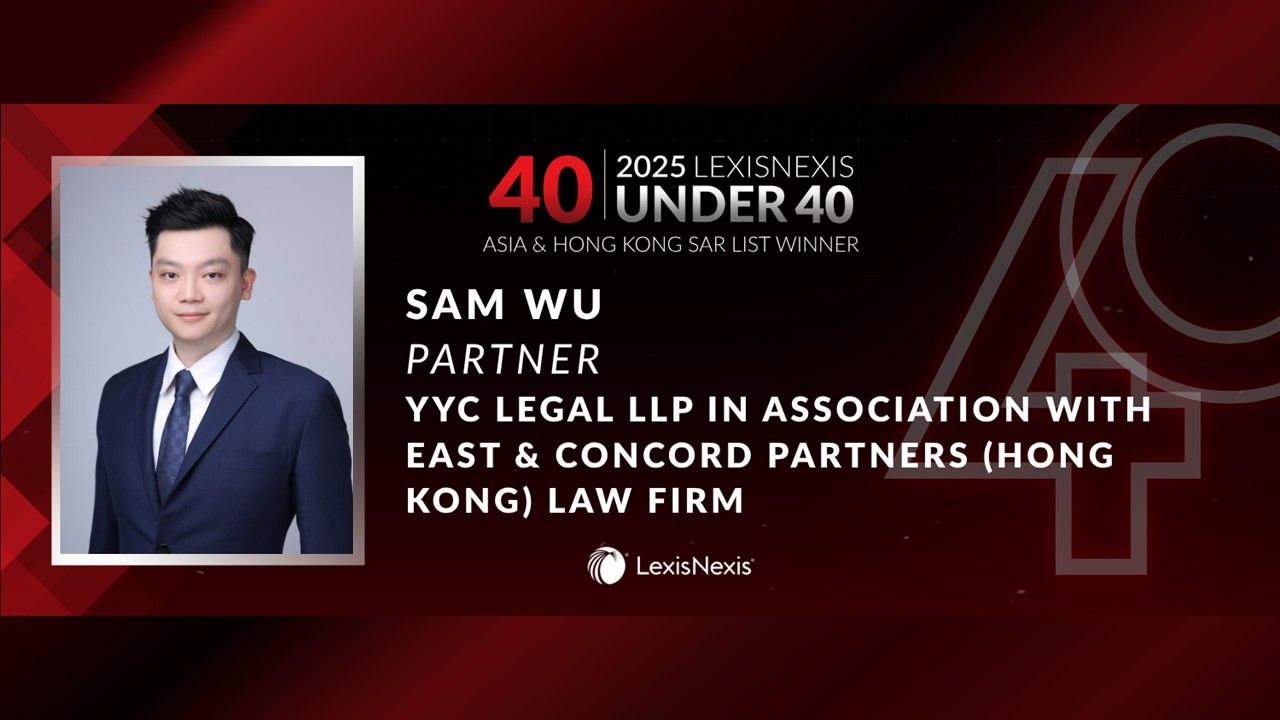
We are pleased to announce that our Partner, Sam Wu, has been selected as a winner in both the LexisNexis® 40 UNDER 40 2025 – Asia List and the Hong Kong SAR List.