




As Hong Kong is one of the largest international financial hub in the world, trading in cryptocurrencies, such as Bitcoins, stablecoins and tokens, is becoming increasingly prevalant in the jurisdiction. With heightened cryptocurrency trading and flow, disputes relating to cryptocurrencies are emerging with lightning speed. Fortunately, the Courts in Hong Kong are extremely well equipped to deal with cryptocurrencies disputes. Many pioneering legal principles have developed in Hong Kong in recent years through a number of Court judgments. This article seeks to highlight a few important cases relating to cryptocurrencies disputes that have emerged in Hong Kong in recent years.
The Development of Crypto Disputes in Hong Kong
Valarie Fung • 13 July 2026
The Development of Crypto Disputes in Hong Kong

Nico Constantijn Antonius Samara v Stive Jean Paul Dan [2022] HKCFI 1254 is one of the first cases pursuant to which a Hong Kong Court has granted a proprietary injunction over cryptocurrencies, i.e. Bitcoins. In this case, the Plaintiff transferred Bitcoins from his personal Bitcoin wallet into the Defendant’s Bitcoin wallet held with Gatecoin Limited (a former cryptocurrency exchange in Hong Kong which is no longer in operation and is in liquidation), so that they could be traded by the Defendant on the Plaintiff’s behalf as his agent. The parties agreed that the proceeds arising from the sale of the Bitcoins would be transferred into a Hong Kong bank account held by the Defendant and could be accessed by the Plaintiff. Later, when the Plaintiff could no longer gain access to the Hong Kong bank account, he commenced legal proceedings against the Defendant for failure to account for his Bitcoins and the sale proceeds.
In November 2019, the Hong Kong Court granted a Mareva injunction freezing the Defendant’s assets up to US$2.6 million. The Court also made a discovery order against the Hong Kong bank account and Gatecoin so that the Plaintiff could trace the flow of the Bitcoins and sale proceeds. Based on further information which the Plaintiff obtained from the discovery order, the Plaintiff applied for and successfully obtained a proprietary injunction over the Bitcoins and sale proceeds and a declaration that the Bitcoins and sale proceeds have been held on trust by the Defendant for the Plaintiff. Although the Hong Kong Court did not specifically deliberate on whether the Bitcoins constituted property, the fact that it granted a proprietary injunction over the Bitcoins and declared that the Bitcoins were held on trust by the Defendant on behalf of the Plaintiff seemingly suggest that the Court accepted that Bitcoins were treated as property under Hong Kong law.
In another case, Yan Yu Ying v Leung Wing Hei [2022] HKCFI 1660, the Hong Kong Court granted a proprietary injunction over Bitcoins which were the subject of a commercial dispute. A notable feature of this case is that it contains the first detailed summary made by a Hong Kong Court on the features of Bitcoin, their storage in wallets and how the wallets are initialized. The Court summarized inter alia that:
- Bitcoin does not involve physical coin. Bitcoin technology is a distributed, peer-to-peer system. Bitcoin users communicate with each other using the Bitcoin Protocol;
- There is no central control or authority that issue Bitcoin. Nor is there any centralized ledger similar to traditional banking and payment systems. Bitcoin transactions are recorded in open distributed ledger using blockchain technology;
- Ownership of Bitcoin is established through digital keys, Bitcoin addresses, and digital signatures;
- A Bitcoin transaction is the operation that allows the payment of Bitcoin from one owner to another. Each Bitcoin transaction requires a valid signature to be included in the blockchain, which can only be generated with valid digital keys. Anyone with a copy of those digital keys has control of the Bitcoin in that account;
- In the payment portion of a Bitcoin transaction, the recipient’s public key is represented by its Bitcoin address, which is used in the same way as the beneficiary’s name on a cheques. The Bitcoin address is generated, and corresponds to a public key;
- Digital keys come in pairs of a private key and a public key. In traditional banking systems, public key is similar to a bank account number, and the private key is similar to a signature on a cheques;
- Digital keys are stored in a “wallet”. A wallet may be “hot”, in the sense that it is connected to the internet, or “cold”, in the sense that it is not. One brand of hardware device in which cold wallet may be created is Trezor. A cold wallet in a Trezor hardware does not actually “store” Bitcoin. The purpose of such a wallet is merely to generate and store the private keys that are associated with the “wallet”. It also provides an interface for carrying out cryptocurrency transactions. One wallet can contain multiple accounts, and one account can contain multiple “addresses”;
- Trezor wallet can receive and send Bitcoin;
- A Trezor wallet needs to be initialized.
The summary provided by the Hong Kong Court in this case has certainly provided a helpful guidance to future Courts dealing with cryptocurrency disputes. Further, the fact that a proprietary injunction was granted in this case is indicative of the fact that Hong Kong Courts have recognized Bitcoins (and other cryptocurrencies) as property in the Hong Kong legal jurisdiction.
The fact that cryptocurrencies are considered as property under Hong Kong law is further reinforced in Re Gatecoin Ltd (In Liquidation) [2023] HKCFI 91. In that case, the Hong Kong Court specifically stated that cryptocurrency is property, which is capable of forming the subject matter of a trust. In its decision, the Court applied the reasoning in the New Zealand case of Ruscoe v Cryptopia [2020] NZHC 728 and held that cryptocurrency satisfies the four criteria for property as explained in National Provincial Bank v Ainsworth [1965] AC 1175. It held that cryptocurrency is a type of intangible property in that:
- It is definable as the public key allocated to a cryptocurrency wallet is readily identifiable, sufficiently distinct and capable of being allocated uniquely to individual accountholder.
- It is identifiable by third parties in that only the holder of a private key is able to access and transfer the cryptocurrency from one wallet to another.
- It is capable of assumption by third parties in that it can be and is the subject of active trading markets where (a) the rights of the owner in that property are respected, and (b) it is potentially desirable to third parties such that they want themselves to obtain ownership of it.
- It has some degree of permanence or stability as the entire life history of a cryptocurrency is available in the blockchain.
Further, the Gatecoin case is landmark in the sense that in a second decision ([2025] HKCFI 493), the Court considered the nature of the relevant parties’ beneficial interest in the cryptocurrencies and discussed how they should be distributed. The Court held that each relevant party is a beneficial tenant-in-common who shares the pool of cryptocurrency between them in proportion to the total account balance of such cryptocurrency. Where there is no shortfall, the relevant party should receive their trust property subject to the payment of administration costs to the Liquidators. Where there is shortfall, the Liquidators should allocate the cryptocurrencies on a proportionate basis using a "pari passu ex post facto" approach, also subject to the payment of administration costs.
In December 2024, the Hong Kong Court made a landmark decision and set a precedent for other legal jurisdictions by issuing the world’s first tokenized injunction order against two cryptocurrency wallets. Before this decision, parties who fell victim to cryptocurrency fraud often faced difficulties in serving injunction orders personally on unknown fraudsters and other relevant parties due to the decentralized nature of blockchain transactions. In Worldwide A-Plus Investment Ltd v A-Plus Meta Technology Ltd HCA 2417/2024, this difficulty was finally overcome. In this case, the Plaintiff, a Hong Kong marketing consultancy firm, transferred USD2.66 million in Tether (USDT) to two wallet addresses of unknown fraudsters on the Tron blockchain. Upon discovering the fraud, the Plaintiff faced the difficulty of identifying the true identity of the wallet owners. Accordingly, the Hong Kong Court made a decision that the injunction order was to be served on the two wallets on the Tron blockchain as a token with a hyperlink to the injunction order. If other people wished to transact with these wallets, they would see the token immediately and acquire notice that the crypto assets in the wallets were subject to legal proceedings.
From granting proprietary injunctions over Bitcoins to recognizing cryptocurrencies as property, and from deliberating the nature of stakeholders’ interest in cryptocurrencies and deciding how they should be distributed in the liquidation of a cryptocurrency exchange to issuing tokenized injunction orders, the Hong Kong Courts have been innovative and have made a number of pioneering decisions in the cryptocurrency space. All of these decisions play a pivotal role in providing a systematic and structured approach to relevant stakeholders in the face of cryptocurrency disputes. In turn, this will strengthen Hong Kong’s position as an international financial hub and provide investors, whether institutional or retail, with enhanced confidence to transact in the cryptocurrency market in Hong Kong.
YYC Legal LLP is in Association with East & Concord Partners (Hong Kong) Law Firm.
This material has been prepared for general informational purposes only and is not intended to be relied upon as professional advice. Please contact us for specific advice.
Recent articles

Technology‑driven companies are no longer judged only on what their AI can do, but on whether they can prove that it is governable, auditable, and investable.

The Northern Metropolis has been incorporated into China's 15th Five-Year Plan, reinforcing Hong Kong’s integration into the nation’s overall development strategy.

HKEX consistently emphasises importance of listed issuers complying with its listing rules. This article discusses several enforcement cases published by HKEX.

This article provides commentary on the consultation launched by HKEX in March 2026 to solicit market feedback on its proposed reforms aimed at listing framework.

The HKSAR government reiterated that it will continue to regulate artificial intelligence mainly through existing regimes and concentrates on governance frameworks, guidelines and supervisory tools that guide institutions in deploying AI responsibly within the existing legal architecture.

HK regulators will implement USM in 2026, enhancing market efficiency, strengthening competitiveness, and modernising the securities market infrastructure in HK.
Recent News

YYC Legal LLP is awarded in the “China Business Law Awards 2026” – international firms – as the Winner in the industry sector category of “Consumer and Retail”.

We are pleased to announce that YYC Legal and Partner Rossana Chu are ranked in Chambers Greater China Region Guide 2026

Rossana Chu is recognised as a Commended External Counsel in the In-House Community’s Counsel of the Year Awards 2025

One of our Partners, Rossana Chu, is ranked by China Business Law Journal as one of The Visionaries (International) for 2025-26.
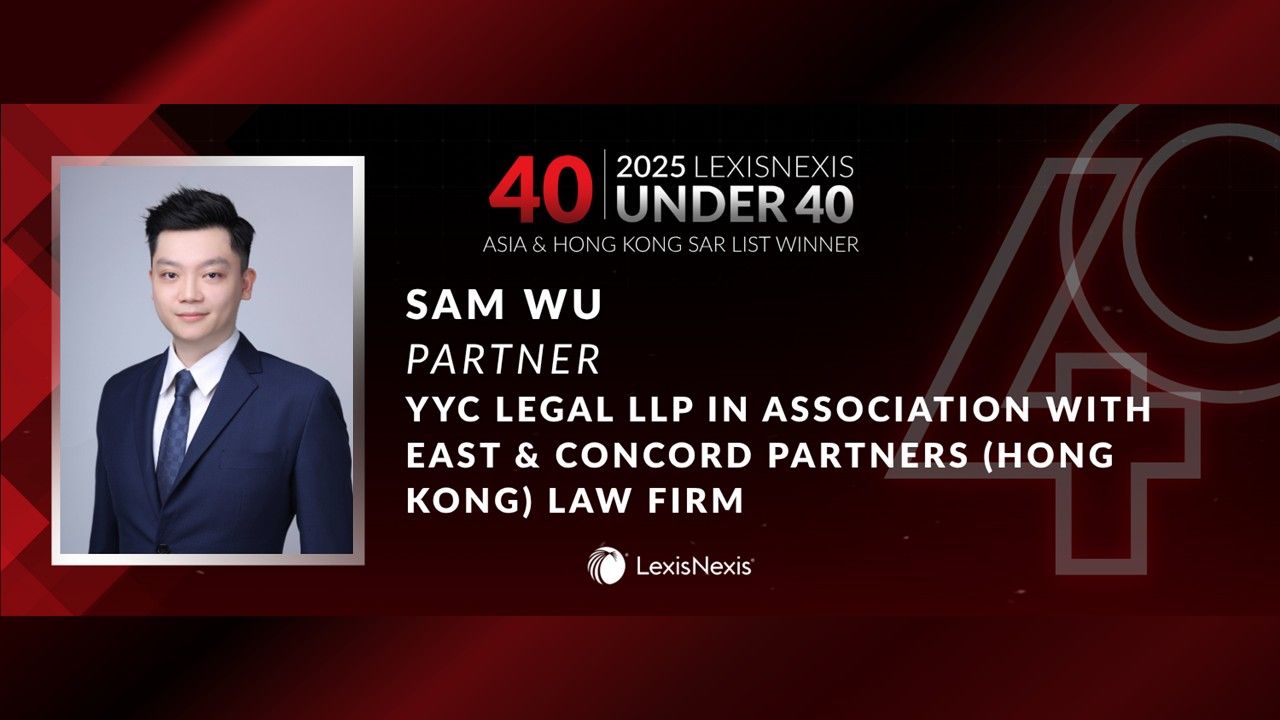
We are pleased to announce that our Partner, Sam Wu, has been selected as a winner in both the LexisNexis® 40 UNDER 40 2025 – Asia List and the Hong Kong SAR List.

We are delighted to announce that YYC Legal LLP (YYC Legal) and our lawyer have been recommended by asialaw as one of the top-performing legal firms and lawyers in Asia.